Today in History, March 14th
On March 14, 1794, Eli Whitney received a patent for the cotton gin. Plus the FBI's first Most Wanted list and Albert Einstein's birth.
Published · Last updated
March 14 is best known for 1794, when Eli Whitney received a patent for the cotton gin, a machine that reshaped the American South. The date also saw the FBI start its “Ten Most Wanted” list in 1950 and the birth of Albert Einstein in 1879.
The big story: Eli Whitney Patents the Cotton Gin (1794)
Eli Whitney was staying on Catherine Greene’s plantation near Savannah, Georgia, when he saw the problem everyone there knew too well. Pulling the sticky seeds out of short-staple cotton by hand was slow, about a pound a day per worker. With Greene’s backing, Whitney built a machine that dragged the fibers through a screen with wire teeth, leaving the seeds behind, while a brush swept the clean cotton away. It could clean as much as 50 times more cotton than a person working by hand. He got his patent on March 14, 1794, but copycat gins spread so fast that he earned little from it. The bigger story was what the gin did to the South. Cotton growing exploded, and so did the demand for enslaved people to plant and pick it. By the middle of the 1800s, the U.S. grew nearly three-fourths of the world’s cotton.
More events on March 14
| Year | What happened |
|---|---|
| 1776 | Alexander Hamilton was named captain of a New York artillery company. |
| 1883 | Karl Marx, co-author of The Communist Manifesto, died. |
| 1950 | The FBI introduced its “Ten Most Wanted Fugitives” list. |
| 1953 | Nikita Khrushchev was chosen for the new Soviet Communist Party Secretariat, a key step in his rise to power. |
| 1958 | The Recording Industry Association of America awarded its first official gold record, to Perry Como for “Catch a Falling Star.” |
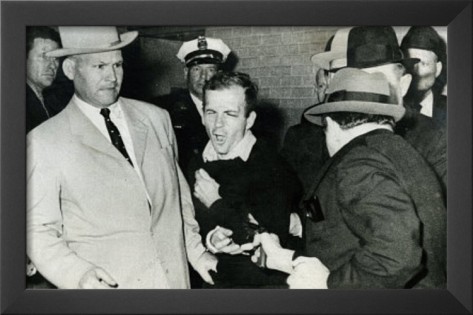
| 1964 | Jack Ruby was found guilty of murdering Lee Harvey Oswald and sentenced to death, in the first courtroom verdict televised in the U.S. |
| 1967 | President John F. Kennedy’s body was moved to a permanent grave near its original site at Arlington National Cemetery. |
| 1979 | Judy Chicago’s feminist art installation The Dinner Party opened at the San Francisco Museum of Modern Art. |
| 1991 | The “Birmingham Six,” wrongly imprisoned for the 1974 Birmingham pub bombings in England, were set free. |
| 2018 | Physicist Stephen Hawking, known for his work on black holes, died in Cambridge, England. |
Born on March 14
- 1879: Albert Einstein, physicist of relativity, born in Ulm, Germany.
- 1933: Michael Caine, British actor with a famous Cockney accent.
- 1933: Quincy Jones, producer, composer and performer from Chicago.
- 1997: Simone Biles, gymnast who won four gold medals at the 2016 Rio Olympics.
Sources
- Eli Whitney patents the cotton gin, History.com
- What happened on March 14, History.com
- March 14, Britannica On This Day
- Karl Marx, History.com
- Stephen Hawking, Britannica
- Albert Einstein: Biographical, Nobel Prize
- Michael Caine, Britannica
- Quincy Jones, Britannica
- Simone Biles, Britannica


